
The locked knee: a clinical reference pageThe locked knee: what it is, and how urgently it needs a surgeon
A truly locked knee cannot be fully straightened, even by hand, because something inside it is in the way, most often a displaced bucket-handle tear of the meniscus. It is sent to the emergency department the same day, to be seen by the on-call orthopaedic team, and an urgent MRI is requested, which never delays the same-day referral. It is not managed with routine physiotherapy.
Written for the clinician seeing the patient first
This page is written for first contact practitioners, advanced practice physiotherapists, MSK physiotherapists and GPs. It is not advice for patients, and it does not replace local pathways or the clinician’s own judgement. Where a statement is Dr Imbuldeniya’s own clinical position rather than published guidance, it says so.
A torn fragment in the way
Dr Imbuldeniya’s teaching, in his words: “Bucket-handle tears can be displaced or non-displaced. If they’re displaced and the torn fragment is in the intercondylar femoral notch, then that causes knee locking. If it’s not there and it’s non-displaced, then normally the knee doesn’t lock. It can intermittently lock if the torn fragment moves in and out of a displaced position, so it can sometimes be locked and then sometimes unlocked.”
Telling a block from a knee that hurts
Orwyn’s locked knee safety rule looks for a true mechanical block: a fixed loss of full passive extension, with a springy end-feel. It is written so that it does not fire for a knee that will not straighten because it hurts, or for catching that comes and goes. Full passive extension, once achieved, points away from it.
The story matters as much as the examination. After an injury in a knee that was good before, a knee that will not fully straighten is treated as a possible locked knee. A knee that has lost extension gradually, over years, as osteoarthritis does, is not an emergency, and that difference is written into Orwyn’s rules.
The same day, for the on-call orthopaedic team
The BASK meniscal guideline recommends urgent arthroscopic surgery for a locked knee. It gives no number of hours or days, and notes that no trial exists in the locked knee. A retrospective study of 60 bucket-handle tears, with an average of 14 days to surgery, found that the time to surgery made no difference to reoperation or outcome, and concluded that repair should be planned with an experienced arthroscopic surgeon rather than done as an emergency. It is small and retrospective, so the evidence is limited, and delays of months are associated with more failures.
A knee that is truly locked, with a fixed block to straightening, for example from a displaced bucket-handle meniscal tear, is sent to the emergency department the same day, to be seen by the on-call orthopaedic team. An urgent MRI is requested, and the request never delays the same-day referral.
History of locking, a scan, or a knee still bent
- A history of locking, the knee not locked today, and an MRI showing a displaced bucket-handle tear: urgent referral to the acute knee clinic, to be seen within days. The letter says so plainly: there is a history of intermittent locking, and the knee is not locked today.
- A knee that still will not fully straighten weeks after an injury, normal before: urgent referral to the acute knee clinic, to be seen within 1 to 2 weeks, with an MRI requested at the same time.
- Catching that frees itself and never stays locked, perhaps with a loose body on the X-ray: request an MRI and refer to the orthopaedic knee clinic for removal, where the patient would consider an operation. If the knee then locks and stays locked, the locked knee rule takes over.
What the patient does, and is told
Crutches for comfort and weight-bearing as pain allows on the way to the emergency department. Physiotherapy starts after the orthopaedic team has seen the patient.
The patient is told: “Your knee is locked: something inside the joint, most likely a torn cartilage (meniscus), is stopping it from straightening. This needs to be seen today. Please go to A&E (the emergency department) today, where the orthopaedic team on call will see you, and take this letter with you. I have also asked for an urgent MRI scan of your knee. Do not wait for the scan before going to A&E.”
How Orwyn handles this
When the examination records a fixed block to straightening, the locked knee safety rule stops routine advice and gives one action: the emergency department the same day, to be seen by the on-call orthopaedic team, with an urgent MRI requested. Orwyn writes the referral and the patient letter. Orwyn's knee safety rules are written and reviewed by its Clinical Safety Officer. The current demonstration (version 0.17, October 2026) uses draft rules awaiting final sign-off, and made-up patients only.
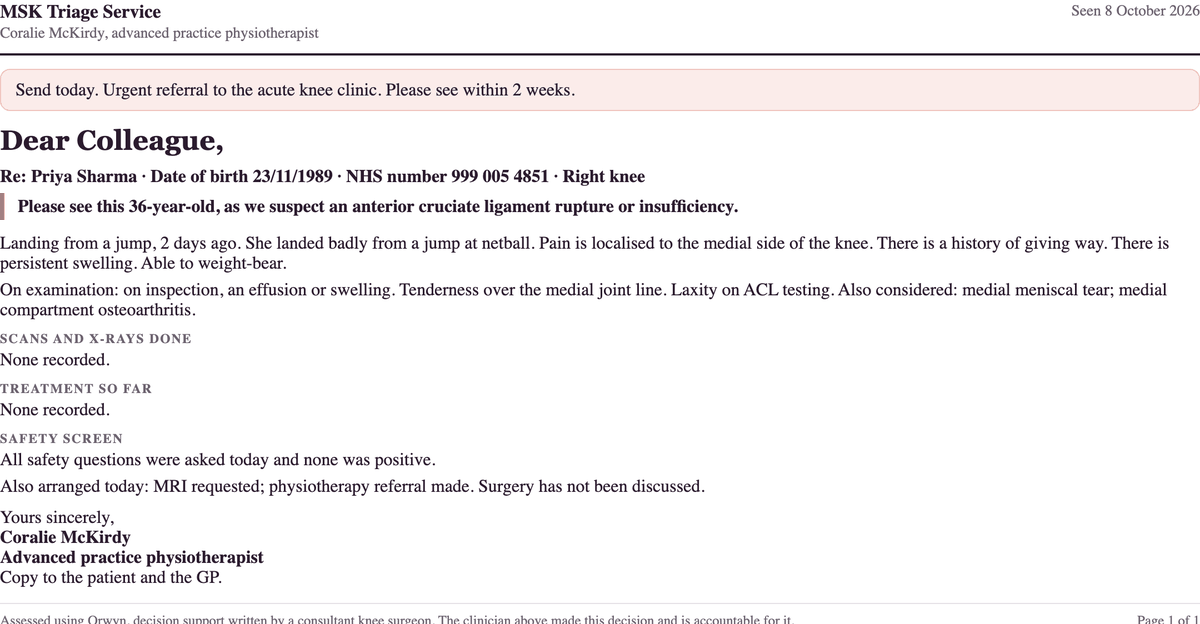
The picture shows the format of a letter Orwyn writes to the acute knee clinic, for a different example patient.
Where this came from
- Abram SGF, Beard DJ, Price AJ, et al. Arthroscopic meniscal surgery: a national society treatment guideline and consensus statement. Bone Joint J 2019;101-B(6):652-659. Read it here.
- Schippers P et al. Bucket-handle meniscal tears might not be an urgency: the time to meniscus repair does not seem to affect the mid-term outcome. J Clin Med 2024. Read it here.
- Knee MRI for suspected meniscal tears. Evidence-Based Interventions, Academy of Medical Royal Colleges. Read it here.
Surgeon-governed decision support for first-contact MSK clinicians.