
Suspected ACL injury: a clinical reference pageSuspected ACL injury: what to do on day one
When a knee is clearly lax after an injury and you suspect an ACL rupture, do three things the same day: refer to the acute knee clinic, request an MRI, and start physiotherapy. The patient should be seen in the clinic within 2 weeks. When you are less certain, request the MRI and start physiotherapy, and review within 2 to 6 weeks, when the knee can be examined properly.
Two or more ligaments lax after an injury (ACL, PCL, MCL or LCL; valgus opening counts as MCL laxity) may mean the knee dislocated. Under 4 weeks from the injury, Orwyn sends the patient to A&E (the emergency department) today. At 4 weeks or more, it sends them to the acute knee service, to be seen within 2 weeks. If a foot pulse is weak or different from the other side, it is a limb emergency: call 999.
Written for the clinician seeing the patient first
This page is written for first contact practitioners, advanced practice physiotherapists, MSK physiotherapists and GPs. It is not advice for patients, and it does not replace local pathways or the clinician’s own judgement. Where a statement is Dr Imbuldeniya’s own clinical position rather than published guidance, it says so.
How it happened gives a clue
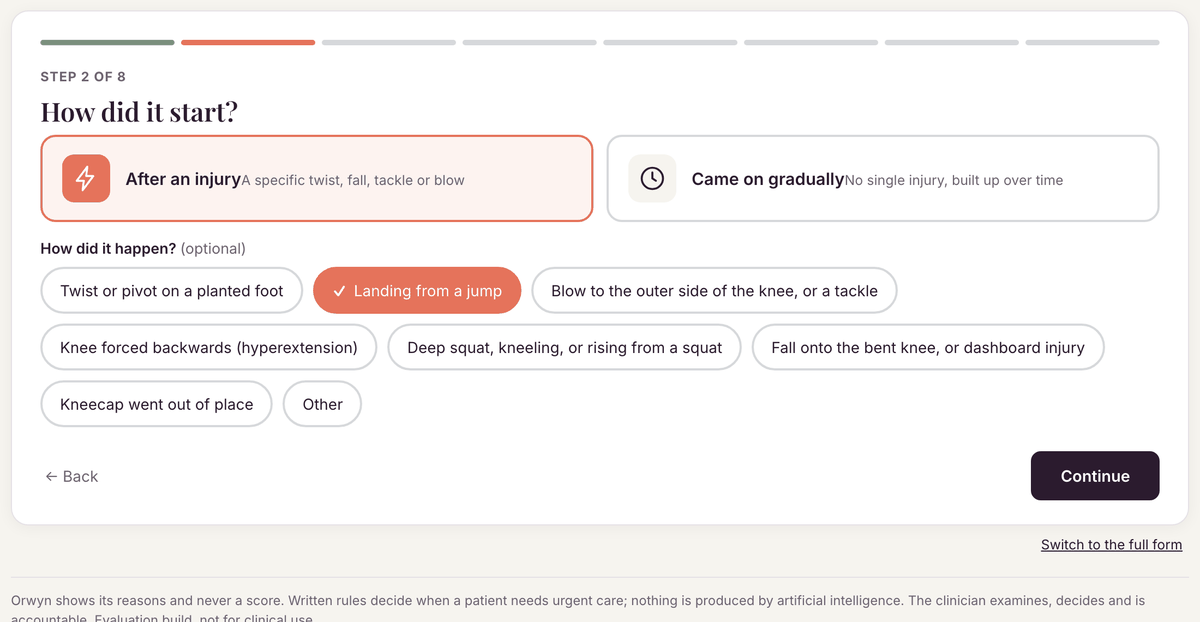
The mechanism of injury moves the likely diagnosis up or down the list. In Dr Imbuldeniya’s teaching, landing from a jump, a pivot on a planted foot or the knee forced backwards, with a pop and swelling within hours, points to the ACL. Deep squatting, or rising from a squat, with joint line pain points to a meniscal tear. A blow to the outer side of the knee points to the MCL, and a high-energy injury with valgus and ACL laxity means thinking of the ACL, the MCL and the medial meniscus together. A fall onto the bent knee, or a dashboard injury, points to the PCL.
The mechanism never overrides the examination. The typical ACL story is a twisting injury with a pop, swelling within hours and giving way, and the typical finding is laxity on Lachman or anterior drawer testing.
Exclude a fracture, and check the knee is not hot
An injured knee that meets the Ottawa Knee Rule needs an X-ray first: see when knee pain needs an X-ray, and which views. Swelling after the injury is expected, because blood in the knee is common after a ligament rupture; it is not a hot, swollen joint, but the question should be asked.
The lax knee, and the less certain knee
Clearly lax, clinician suspicious: refer the same day to the acute knee clinic, request the MRI and start physiotherapy. If the scan is normal, that is acceptable. The BASK and BOSTAA best practice document sets assessment in an acute knee injury clinic within 2 weeks of presentation, with MRI as the imaging of choice. An ACL and an MCL injury together are more urgent than one ligament alone.
Two or more ligaments lax after an injury (ACL, PCL, MCL or LCL; valgus opening counts as MCL laxity) may mean the knee dislocated. Under 4 weeks from the injury, Orwyn sends the patient to A&E (the emergency department) today. At 4 weeks or more, it sends them to the acute knee service, to be seen within 2 weeks. If a foot pulse is weak or different from the other side, it is a limb emergency: call 999.
Less certain: request the MRI, start physiotherapy and hold the referral. Review within 2 to 6 weeks to check the result and that physiotherapy is happening, and re-examine then: a knee is often too sore and swollen to examine well at first. Refer to the acute knee clinic if the knee is lax or the scan shows a rupture.
The MRI is only worth requesting if the knee clinic can see scans ordered by the service. Where it cannot, the referral goes without the scan, and says why.
Late presenters, months to a year after the injury, are not urgent.
When the ACL has been reconstructed before
A knee that has had an ACL reconstruction and now presents like a rupture is a suspected graft rupture. After a new injury it follows the same day-one plans, with weight-bearing AP and lateral X-rays added to show the tunnels and the fixation. The letter states the previous reconstruction, with the year, the graft and the surgeon where known, and asks for the original surgeon or a soft tissue knee surgeon. With no new injury, only gradual giving way: MRI, the same X-rays, physiotherapy, and a routine referral to the original surgeon or a soft tissue knee surgeon. A CT scan for tunnel widening is the surgeon’s decision and is never requested at first contact.
The patient’s page
The patient is asked to start the physiotherapy exercises now, because getting the swelling down, the knee fully straight and the thigh muscle working again matters whatever is decided later, and to avoid twisting and pivoting sport until they have been seen.
The surgeon’s section of their page says: not everyone with a torn ACL needs an operation. What decides it is whether the knee keeps giving way and what the patient wants to get back to, not the scan alone. If another structure is injured at the same time, it is more urgent, and that is why they are seen quickly. The patient decides with the surgeon.
How Orwyn handles this
One tap records how the injury happened, on the same screen as the injury itself, with a few optional words for the sport or activity. That line is copied into the clinic note, the referral, the physiotherapy referral and the imaging request, and into the reasons shown under the most likely diagnosis.
The physiotherapy referral opens “Please assess and treat” and leaves the treatment plan to the physiotherapist.
Where this came from
- Best practice for management of anterior cruciate ligament (ACL) injuries. British Association for Surgery of the Knee and British Orthopaedic Sports Trauma and Arthroscopy Association, published by the British Orthopaedic Association, 2020. Read it here.
- Stiell IG et al. Implementation of the Ottawa Knee Rule for the use of radiography in acute knee injuries. JAMA 1997;278:2075-2079. Read it here.
Surgeon-governed decision support for first-contact MSK clinicians.