First contact clinicians already make this decision every day, and the great majority of those decisions are right. The weak part is the system around them. A patient can be sent for a surgical opinion that was never going to lead to an operation, and wait months to hear it. Another can be managed for a year with a problem that needed surgery sooner. Neither is a failure of the clinician in the room. The specialist thresholds being applied downstream, and what eventually happened to the referral, are not visible at the point the decision is made.
Musculoskeletal means the joints, muscles, bones and soft tissues. First contact practitioners are the clinicians who see these patients before anyone else, usually in general practice or a community service: most often physiotherapists, and also GPs, osteopaths, podiatrists, sports and exercise medicine doctors, and the advanced practitioners who run triage clinics. They are experienced and they are not the problem. The problem is that the system shows none of them the surgical end of the pathway, and gives them no way to reach a surgical opinion at the moment the decision is actually made.
Most patients do not need it. An experienced clinician is certain about most of the people they see, and existing triage stays exactly where it is. Orwyn is for the referral decisions where the surgical question is genuinely in play, and for making the reasoning visible to both clinician and patient when it is.
Orwyn is not a patient app and not a questionnaire the patient fills in at home. It sits with the clinician while the patient is in front of them, and it fits inside a normal appointment.
Orwyn runs on rules a named consultant surgeon has written and signed off, built from the strongest available research evidence and national guidance: NICE, the Getting It Right First Time programme and the British orthopaedic specialist societies, including the British Orthopaedic Association, the British Association for Surgery of the Knee and the British Hip Society. It is not a model whose reasoning cannot be inspected. Anyone reviewing a decision can be shown why it was made.
Orwyn does not check, approve or oversee the clinician's work. It carries a surgeon's judgement into a room the surgeon is not in. The clinician assesses the patient and decides.
The surgical end has its own bias. Surgeons are trained, paid and measured on operating, and the clinic sees the patient only after someone has already framed the question as a surgical one. Writing the criteria down, with the evidence behind each one, is a constraint on the surgeon as much as anything else. It means the threshold can be argued with.
Most of the harm in this pathway does not come from a single wrong decision. It comes from a right decision the patient does not accept, a difficult case nobody senior ever sees, and a clinician who never learns what happened to the patient they sent.
At the end of the appointment the patient is given the plan the clinician has agreed with them, in plain English, by text or on paper. It says what was decided, why, and what would change the answer. Where a consultant has reviewed the case it says so. Nothing is asked of the patient in return: there is no app to download, no account, no diary to fill in, and nothing is collected back from them.
This exists because of a finding we did not expect. Clinicians told us, independently of each other, that patients accept the same advice differently depending on who appears to stand behind it. A decision not to operate is far easier to accept when the reasoning is visible and a surgeon's criteria are attached to it.
No set of written criteria settles every patient, and the ones it cannot settle are usually the ones who most need judgement. Orwyn identifies those cases and prepares them, in a structured form, for an existing multidisciplinary meeting: what was tried and for how long, the imaging and its dates, and why the criteria did not resolve it. The decision, the reason and the responsible clinician are recorded, and the letters to the patient and the GP are drafted from them.
Orwyn does not hold the meeting, does not schedule it and does not make the decision. It removes the preparation time that makes consultant sessions too expensive for most community services to justify.
When a first contact clinician refers a patient, the outcome letter goes to the GP and the patient leaves the community service. The clinician who made the decision usually never learns what happened. There is no loop anywhere in this pathway, which is a strange way to run a system that depends on those decisions being good. For the terms behind this, see MSK referral optimisation, MSK triage explained, and who first contact practitioners are.
Orwyn returns the outcome to the clinician who made the referral. It is theirs and theirs alone. There is no league table, no ranking, no comparison against colleagues and no report to a line manager. Feedback to a clinician is how anyone improves. Comparison between clinicians is something else, and we have deliberately built it so that it cannot be done.
Every decision, disagreement and outcome is recorded, and none of it changes how Orwyn behaves. The rules change only when a named consultant surgeon changes them, in writing, with a version number and a date, so that any decision can be traced to the exact rule that produced it. That is a deliberate constraint and not a limitation we intend to remove.
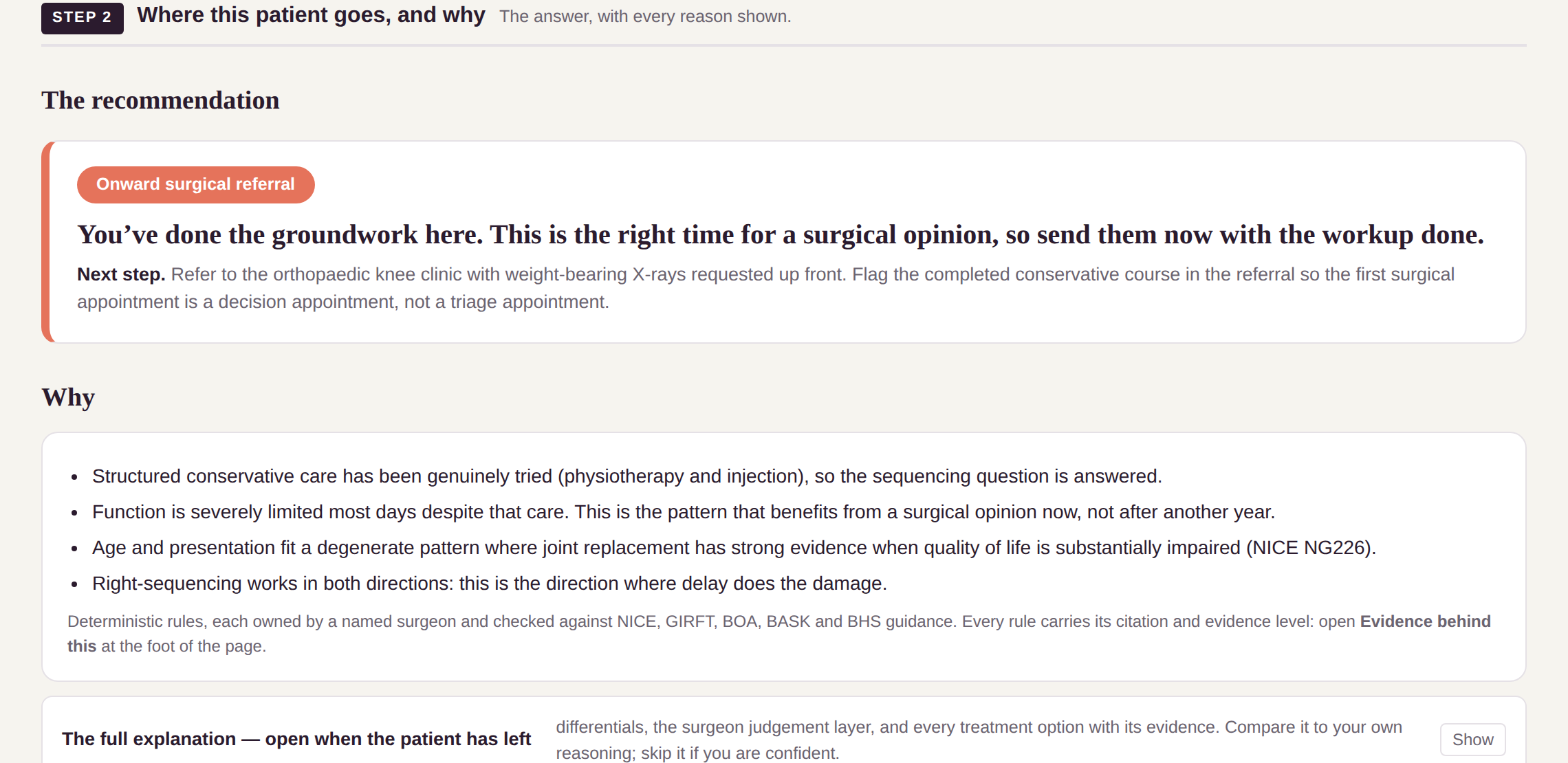
The suggested next step, the reasons behind it with their rule numbers, the evidence each rule rests on, the control to disagree, and what would change the answer, on one screen, inside a normal appointment.
Orwyn was designed from frontline NHS practice. It draws on decades of seeing and treating thousands of patients, surgically and non-surgically, and on conversations about this problem with physiotherapists, advanced practice physiotherapists, first contact practitioners, GPs, sports and exercise medicine doctors, radiologists and orthopaedic surgeons for over a decade. The consensus, wherever the question was asked, was the same. Better decisions for patients are made together.
The criteria are built from the highest quality evidence available in published research and national guidance, combined with that clinical experience. When a consultant surgeon and a physiotherapist work side by side, patients reach the right decision sooner. Orwyn exists to make that working relationship available in every clinic, at a cost the NHS can afford.
Written rules, a named surgeon behind them, and safety questions that must be answered first.
Safety and how it is built