Orwyn brings consultant orthopaedic surgical judgement into the room, written down, grounded in evidence and explainable, at the moment the referral decision is made.
Surgery when it's needed. Certainty when it's not.
First contact clinicians already make this decision every day, and the great majority of those decisions are right. The weak part is the system around them. A patient can be sent for a surgical opinion that was never going to lead to an operation, and wait months to hear it. Another can be managed for a year with a problem that needed surgery sooner. Neither is a failure of the clinician in the room. The specialist thresholds being applied downstream, and what eventually happened to the referral, are not visible at the point the decision is made.
NHS England calls the work of getting this right MSK referral optimisation, and it is not the same as reducing referrals. We explain the terms in plain English: what MSK clinical decision support is, how MSK triage works, and who first contact practitioners are.
Both directions are good outcomes. Without shared thresholds a patient drifts, into an unnecessary specialist wait or a delayed escalation. The outcome is returned to the first contact clinician.
The suggested next step, the reasons behind it with their rule numbers, the evidence each rule rests on, the control to disagree, and what would change the answer, on one screen, inside a normal appointment.
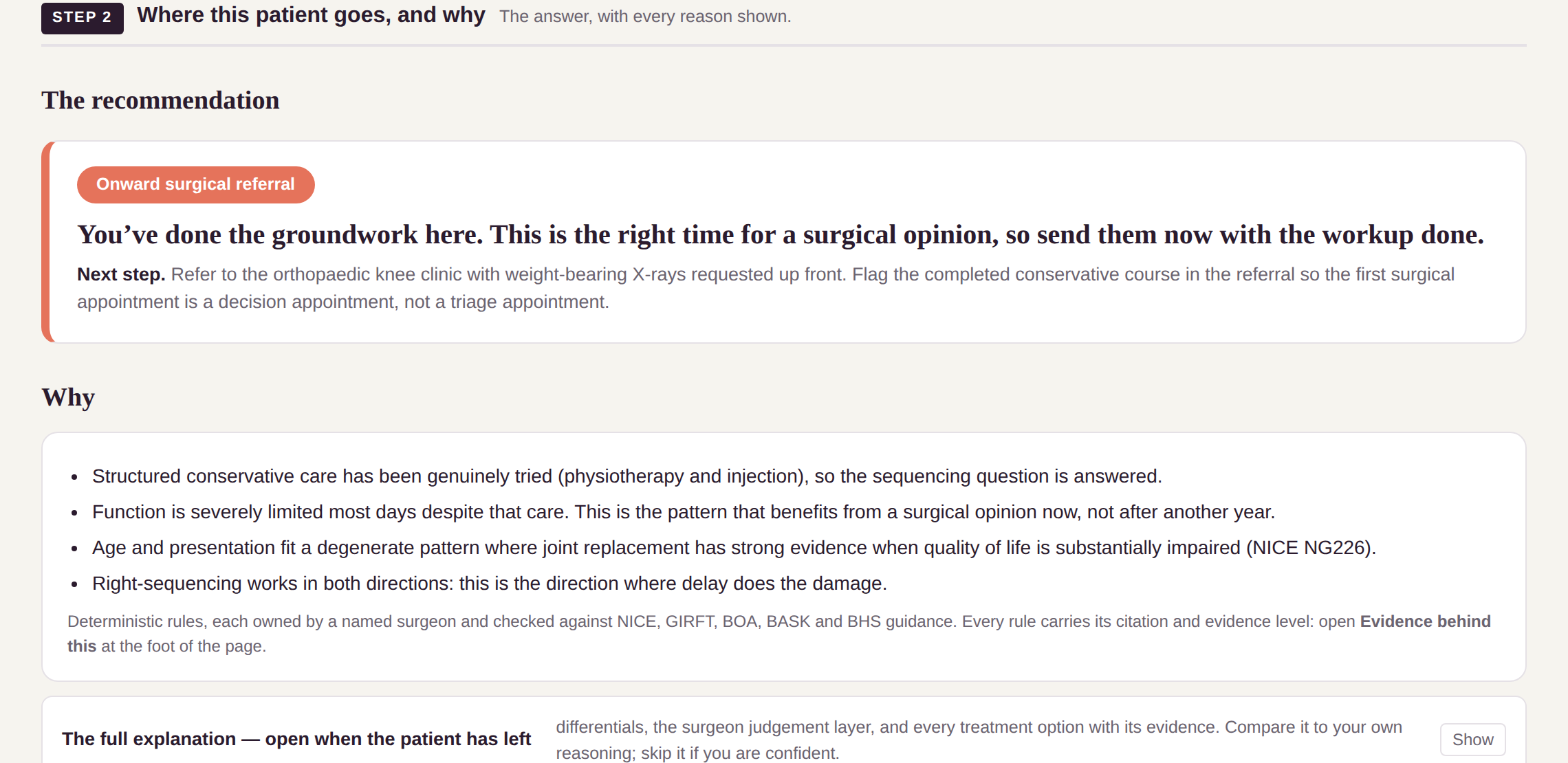
Most patients do not need it. An experienced clinician is certain about most of the people they see, and existing triage stays exactly where it is. Every suggestion Orwyn makes comes with the reason for it, in plain words. There are no scores and no percentages. The clinician can disagree and record why, and that disagreement is kept.
Orwyn is not a patient app and not a questionnaire the patient fills in at home. It sits with the clinician while the patient is in front of them, and it fits inside a normal appointment. This is clinician-facing decision support rather than patient self-triage, and the difference matters.
Orwyn runs on rules a named consultant surgeon has written and signed off, built from the strongest research evidence and national guidance. It is not a model whose reasoning cannot be inspected: anyone reviewing a decision can be shown why it was made.
Orwyn does not check, approve or oversee the clinician's work. It carries a surgeon's judgement into a room the surgeon is not in. The clinician assesses the patient and decides.
A decision on its own changes very little. What makes a plan hold is that the patient believes it, that the difficult cases still reach a surgeon, and that the clinician finds out what happened.
Nothing else appears until every safety question has been answered. An unanswered question is never read as a no, and anything that should not wait is named, with where the patient should go and how quickly.
One suggested next step, in plain words, with the reasoning shown and the evidence behind each part of it. The clinician can disagree, and the disagreement is recorded rather than overruled.
The plan the clinician has agreed with the patient, in plain English, texted or printed in the room. What was decided, why, and what would change the answer. A decision not to operate arrives as an answer rather than a refusal.
Some patients cannot be settled by any criteria, and those are usually the ones who most need judgement. Orwyn prepares them for an existing multidisciplinary meeting, and records the decision and who made it. It does not hold the meeting or make the decision.
Today a referral is made and the outcome goes somewhere else, so the clinician who decided never learns what happened next. Orwyn sends that outcome back to them. It is theirs alone: never a comparison with colleagues, never a report to a manager.
Every decision, every disagreement and every outcome is recorded, so a service can show what changed rather than assert it. Nothing about how Orwyn behaves changes by itself: rules change only when a named surgeon changes them, in writing, with a version and a date.
Orwyn is being developed with NHS musculoskeletal clinicians, and is designed for NHS Trusts and the services that commission musculoskeletal care.
See the demoDiscuss an NHS pilot