
The hot, swollen knee: a clinical reference pageThe hot, swollen knee: what must happen the same day
A short history of a hot, swollen, tender knee with restricted movement is septic arthritis until proven otherwise, with or without a fever. The joint needs aspirating, and the fluid sent for Gram stain and culture, before any antibiotic is given. That cannot happen in a first contact clinic, so the patient needs the right hospital team the same day.
Written for the clinician seeing the patient first
This page is written for first contact practitioners, advanced practice physiotherapists, MSK physiotherapists and GPs. It is not advice for patients, and it does not replace local pathways or the clinician’s own judgement. Where a statement is Dr Imbuldeniya’s own clinical position rather than published guidance, it says so.
What the hot swollen joint guideline says
The guideline for managing the hot swollen joint in adults, from the British Society for Rheumatology with the British Orthopaedic Association, the Royal College of General Practitioners and the British Society for Antimicrobial Chemotherapy, is explicit on five points.
- Patients with a short history of a hot, swollen and tender joint with restricted movement should be regarded as having septic arthritis until proven otherwise.
- If clinical suspicion is high, the joint is treated as septic even in the absence of fever.
- GPs and emergency doctors should refer patients with suspected septic arthritis to a specialist within the hospital who has the expertise to aspirate the joint.
- The synovial fluid must be aspirated, Gram-stained and cultured before antibiotics are started.
- A possibly infected prosthetic joint should always be referred to an orthopaedic surgeon.
A new British Society for Rheumatology guideline is in development. This page will be updated when it is published.
What must happen, where and when
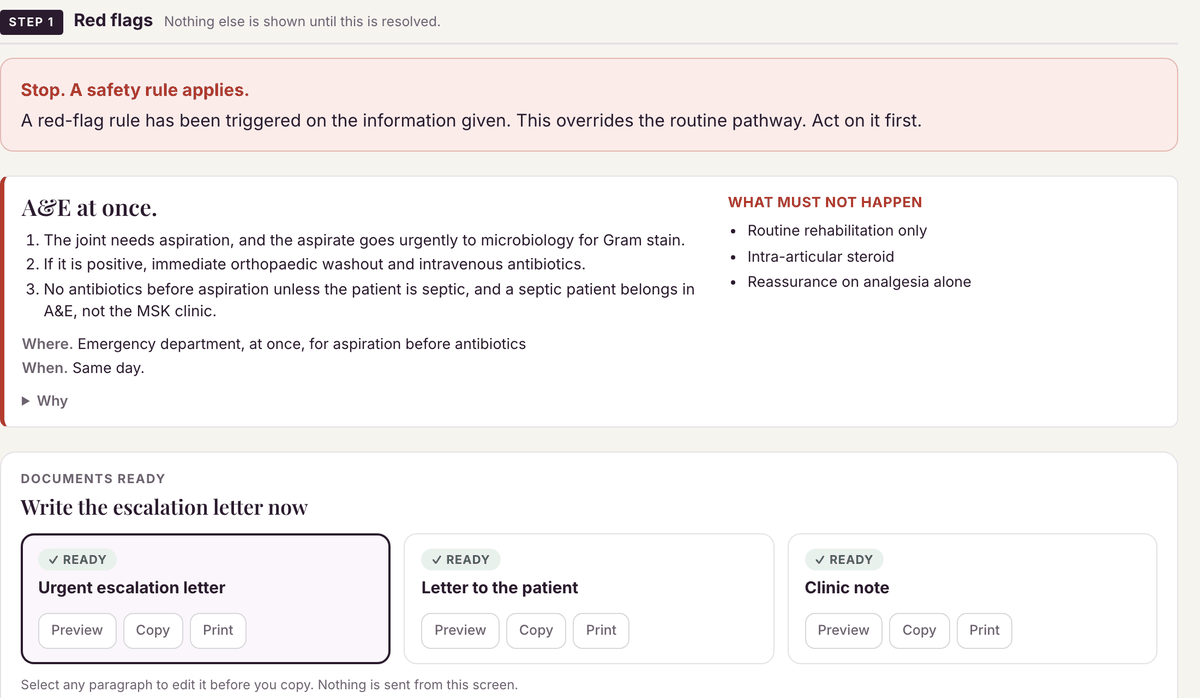
Orwyn scores the features of infection. A very unwell or feverish patient is sent to A&E now. It sets out what happens there, so the first contact clinician can explain it to the patient and put it in the letter.
- The joint needs aspiration, and the aspirate goes urgently to microbiology for Gram stain.
- If it is positive: immediate orthopaedic washout and intravenous antibiotics.
- No antibiotics before aspiration unless the patient is septic, and a septic patient belongs in A&E, not the MSK clinic.
Three things must not happen: routine rehabilitation on its own, a steroid injection into the joint, and reassurance with pain relief alone.
The hot, swollen replacement
A hot, swollen knee replacement goes to the orthopaedic team the same day, by a call or an urgent referral, and to A&E only if the patient is unwell. That follows the guideline’s line that a possibly infected prosthetic joint should always be referred to an orthopaedic surgeon, and the British Orthopaedic Association’s standard on peri-prosthetic joint infection, which sends red flags of acute infection for emergency review by the on-call orthopaedic team and asks for no antibiotics before aspiration unless the patient is septic.
The patient is told: “Your knee needs to be seen by the orthopaedic team today. I have spoken to them and they are expecting you. Please go to [place] now, and take this letter with you.”
Swelling after an injury is different
Blood in the knee after a ligament rupture is expected, and it is not a hot, swollen joint. An effusion recorded after an injury does not stop the consultation. It raises a reminder instead, “Effusion recorded. Confirm the knee is not hot”, so the question is asked and answered rather than assumed. For the injured knee, see suspected ACL injury: what to do on day one.
How Orwyn handles this
The safety questions come first, and nothing else appears until the clinician has confirmed them. When the hot, swollen knee rule applies, Orwyn shows one clear action, where and when it happens, and what must not happen, and writes the escalation letter: “Please see this [age]-year-old today, as we suspect” the condition in question. Nothing is sent from the screen: the clinician checks and sends it.
Orwyn's knee safety rules are written and reviewed by its Clinical Safety Officer. The current demonstration (version 0.17, October 2026) uses draft rules awaiting final sign-off, and made-up patients only.
Where this came from
- Coakley G, Mathews C, Field M, et al. BSR & BHPR, BOA, RCGP and BSAC guidelines for management of the hot swollen joint in adults. Rheumatology 2006;45:1039-1041. Read it here.
- Speciality Standards: peri-prosthetic joint infection. British Orthopaedic Association. Read it here.
Surgeon-governed decision support for first-contact MSK clinicians.